Mostrando entradas con la etiqueta Fibonacci series. Mostrar todas las entradas

domingo, 21 de enero de 2018

Neruda and Fibonacci, a curious coincidence

Neruda and the Fibonacci numbers. Twenty Love Poems


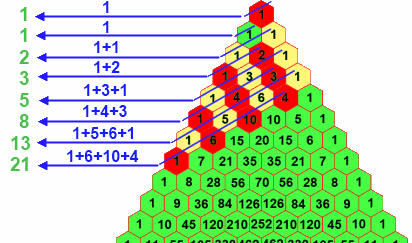
In mathematics, the Fibonacci sequence is the next infinite sequence of natural numbers:

0,1,1,2,3,5,8,13,21,34,55

The sequence begins with the numbers 0 and 1,2 and from these, "each term is the sum of the previous two; and the elements of this sequence are called Fibonacci numbers. This succession was described in Europe by Leonardo of Pisa, Fibonacci, Italian mathematician of the thirteenth century.

It has numerous applications in computer science, mathematics and game theory. It appears in biological configurations, such as the branches of the trees, the arrangement of the leaves on the stem, in the flowers of artichokes and sunflowers, in the configuration of the pineapples of the conifers; in the spiral structure of the shell of some mollusks, like the nautilus. It is a series of magic numbers.


Pablo Neruda, pseudonym of Neftali Ricardo Reyes (July 1904, September 1973) was a Chilean poet and winner of the Nobel Prize for Literature in 1971. One of his works, "Twenty Love Poems and a Song of Despair" published in 1924 , has 21 poems. A Fibonacci number. Did Neruda know that, or is it that mathematics and its magic numbers also have mysterious ways of infiltrating creative activity? I do not know, it does not matter. Mathematics is beautiful, and mysterious, poetry is beautiful and just one button is enough. I present to you the Poem 20.


Poem 20

I can write the saddest verses tonight.

Write, for example: "The night is starry,
and they shiver, blue, the stars, in the distance ".
The night wind spins in the sky and sings.

I can write the saddest verses tonight.

I loved her, and sometimes she loved me too.
On nights like this I held her in my arms.
I kissed her so many times under the infinite sky.
She loved me, sometimes I also loved her.
How not to have loved her great still eyes.

I can write the saddest verses tonight.

To think that I do not have her. Feeling I've lost her.
Hear the inmense night, even more without her.
And the verse falls to the soul as to the grass the dew.
Does it matter that my love could not keep it.
The night is full of stars and she is not with me.
That is all. In the distance someone sings. In the distance.

My soul is not content with having lost it.
As if to bring it closer my gaze searches for it.
My heart looks for her, and she is not with me.
The same night whitening the same trees.
We, the ones then, are not the same.

I no longer love her, it's true, but how much I loved her.
My voice searched the wind to touch her ear.
Of other. Will be from another. As before my kisses.
Her voice, her bright body. His infinite eyes.

I no longer love her, it's true, but maybe I love her.
Love is so short, and oblivion is so long.
Because on nights like this I held her in my arms,
My soul is not content with having lost it.

Although this is the last pain that she causes me,
and these are the last verses that I write to you.

IN SPANISH:


References

Sucesión de Fibonacci

Pablo Neruda


Neruda dan Fibonacci, sebuah kebetulan yang aneh

Neruda dan angka Fibonacci. Dua Puluh Puisi Cinta


Dalam matematika, deret Fibonacci adalah urutan tak berhingga bilangan natural berikutnya:

0,1,1,2,3,5,8,13,21,34,55

urutan dimulai dengan angka 0 dan 1,2 dan dari ini, "setiap istilah adalah jumlah dari dua sebelumnya; dan elemen dari urutan ini disebut angka Fibonacci. Urutan ini digambarkan di Eropa oleh Leonardo of Pisa, Fibonacci abad ketiga belas matematikawan Italia.

Ini memiliki banyak aplikasi dalam ilmu komputer, matematika dan teori permainan. susunan lembaran dalam batang, bunga artichoke dan bunga matahari, dalam konfigurasi dari kerucut dari konifer muncul dalam pengaturan biologi, seperti cabang-cabang pohon ,; dalam struktur spiral kerang dari beberapa moluska, seperti nautilus. Ini adalah serangkaian angka ajaib.


Pablo Neruda, nama samaran dari Neftali Ricardo Reyes (Juli 1904, September 1973) adalah seorang penyair Chili dan pemenang Hadiah Nobel untuk Sastra pada tahun 1971. Salah satu karyanya, "Dua puluh Puisi Cinta dan Song of Despair" yang diterbitkan pada tahun 1924 , memiliki 21 puisi. Angka Fibonacci Apakah Neruda itu, atau adalah bahwa matematika dan nomor ajaib, juga memiliki cara misterius menyusup aktivitas kreatif? Saya tidak tahu, tidak masalah. Matematika itu indah, dan misterius, puisi itu indah dan hanya satu tombol yang cukup. Saya sampaikan kepada anda Puisi 20.


Puisi 20

Saya bisa menulis ayat yang paling menyedihkan malam ini.

Tulislah, misalnya: "Malam itu berbintang,
dan mereka menggigil, biru, bintang-bintang, di kejauhan ".
Angin malam berputar di langit dan bernyanyi.

Saya bisa menulis ayat yang paling menyedihkan malam ini.

Aku mencintainya, dan terkadang dia juga mencintaiku.
Pada malam hari seperti ini aku memeluknya.
Aku menciumnya berkali-kali di bawah langit yang tak terbatas.
Dia mencintaiku, terkadang aku juga mencintainya.
Betapa tidak dicintai matanya yang besar.

Saya bisa menulis ayat yang paling menyedihkan malam ini.

Untuk berpikir bahwa saya tidak memilikinya. Merasa bahwa aku telah kehilangan itu.
Dengarkan malam yang sangat besar tanpa dia.
Dan ayat itu jatuh ke dalam jiwa seperti rumput embun.
Apa bedanya cintaku tidak bisa menyimpannya.
Malam itu berbintang dan dia tidak bersamaku.
Itu saja Di kejauhan seseorang bernyanyi. Di kejauhan

Jiwaku tidak puas karena telah kehilangannya.
Seolah mendekatinya, tatapanku mencari jawabannya.
Hatiku mencari dia, dan dia tidak bersamaku.
Malam yang sama membuat pohon itu putih putih.
Kami, yang sekarang, tidak lagi sama.

Aku tidak lagi mencintainya, itu benar, tapi betapa aku mencintainya.
Suaraku berusaha angin menyentuh telinganya.
Dari yang lain. Itu akan menjadi milik orang lain. Seperti sebelum ciuman saya.
Suaranya, tubuhnya jernih. Matanya yang tak terbatas

Aku tidak lagi mencintainya, memang benar, tapi mungkin aku mencintainya.
Cinta begitu singkat, dan dilupakan begitu lama.
Karena pada malam hari seperti ini aku memeluknya,
Jiwaku tidak puas karena telah kehilangannya.

Meskipun ini adalah rasa sakit terakhir yang dia sebabkan kepadaku,
dan ini adalah ayat terakhir yang saya tulis kepada Anda.

EN ESPAÑOL:


Referensi

Sucesión de Fibonacci

Pablo Neruda